Year of the Positron
What happened last year? Why will businesses give away control over fat stacks of cash to freeloading hippies this year? How will developers take their overdue cut while delivering us all to software nirvana? Join us as we evolve the natural alliances.
The Story Behind the 26
What a sign of luck! Our logo has become a prophecy for the year of our series-A funding round!
Early on, we were hedging on maybe doing a Rust consultancy, focusing on Rust usage in the cloud, but Ferrous Systems had already taken the coolest possible name. Rust contains iron. The 26 protons in an iron nucleus have the same charge as 26 positrons.
Gather Your Errors to Define the Gradients
What was bad last year? If something was bad, what are robust reasons it will get better this year?
Team Building
Sometime around June, we started testing the waters with recruiting. We found someone appropriate. We're sure they were plenty capable. They could not begin moving code around. This told us that our product and tech were all still just too unclear.
Ready to Try Again
Now that PrizeForge and its code look approximately like a service-shaped application with obvious places to start work, we should really recruit again. With µTate open for contributions, as the code becomes more professional, we can hire from people who don't ask for permission to move.
Broken Basics
Bay Area startup orthodoxy says ship something yesterday. Get out of the vacuum! Talk to people! We cut corners to make that happen. We learned things, excellent things about how we will ultimately present PrizeForge, but we were also burning too much goodwill.
At launch, we knew single-sign-on was working. We made it the first option. We shipped totally broken email sign-up, anticipating our brilliant users, who are totally smarter than "useless" chatbots, would quickly home in on SSO.
We had also decided to focus on Emacs users first. Emacs users love email. They mistrust Google almost more than they mistrust us. We lost something like 90% of sign-ups. Improvements were made. Still yet, neither party was impressed with the other.
One Time Costs Only Bite Once
We chose Rust tooling in order to obtain certain capabilities and dividends. Part of that meant a lot of writing basic stuff from scratch. Things like session management and sending emails were just not nearly as "for free" as they might be with some typescript framework. Session security is not optional.
Tech changes fast. We used newly available, clearly better things rather than familiar things with familiar problems. There were so many little questions like "Will CNPG be reliable on Kubernetes?" and how to share frontend and backend structure.
Those one-time costs simply had to be paid. Because they are one-time costs, they won't come back. We are mostly in the dividends phase of the investment. New features will re-use all of that. We could build PrizeForge again in probably a quarter of the time.
Year of the Celestial Emacsen
2025 could have been that year. Lisp is good. Around January, we had made some interesting LLM tool integrations that looked super-promising. Emacs could introspect Emacs, searching, summarizing, and translating Emacs documentation and looking up the Elisp inside running packages in order to retrieve solid reference input and chase down behaviors. That's freaking awesome!

Then we found the headwinds. Emacs is not what it was in 2005. While it is absolutely better, it has relatively slipped against everything else. Emacs has nearly disappeared from developer surveys except as a write-in. Simultaneously, self-selection has distilled within the community some of the most staunch opponents of AI, whatever that means to those who are also staunch opponents of javascript.
Meanwhile, through developing a message to talk about the value open source can provide and why social finance makes excellent sense, we wound up instead agreeing with Linus that the FSF has truly and completely lost it. This is bad because the FSF has de facto gatekeeping power over Emacs development and an ideological choke hold over the user community.
We wanted to pay forward deep LLM integrations into a programmable user interface, knowing that local LLMs and other AI are the future. The infamous RMS could be found on the mailing list like a gargoyle, ruminating over the usual FSF dogma swamp while force-feeding cond* to package developers and bike shedding wherever possible, the tried & true poisonous bullfrog strategy that protects so many open source fiefdoms from unwanted success.
(╯°□°)╯︵ ┻━┻
At length, one of our 2026 resolutions is to switch to Lem. We recommend others join us in jumping ship. Development is racing away and the community is all gas no brakes. Common Lisp is a better Lisp and benefits from an existing ecosystem. Sacrificing our user freedoms to the tyrannical MIT license is great breath of fresh air!
Since we no longer want to develop in Elisp or contribute anything to the Emacs ecosystem, we lost the natural alignment of paying open source forward in return for feedback and users for PrizeForge. Something had to give.
Please Stop Paying Us (on Github)
To add insult to injury, we have several times emailed our Github sponsors, asking them to migrate over to PrizeForge. They have continued paying us via Github, probably lost in their myriad monthly subscriptions.
This showed us that the people we were approaching were not heavily engaged and maybe really did just want Emacs tutorials. What we are trying to do is a little bit indirect. Customers are only used to seeing direct. Insert coin. Crank handle. Get prize.
The Pivot
Programmer tools have a limited market. Programmers rightly feel that any revenue has to come in from the outside, from consumers and businesses. Expecting a GDP within the programmer ecosystem is unsustainable and untrustworthy.
Programmers already have "free software" (free beer) enthusiasts demanding to bum off of us. We don't need programmers bumming off each other too.
Instead of working on programmer tools, we're switching things up. We pay forward by developing µTate, a music visualizer that has obvious benefit for the millions of consumers we need to get our message in front of.
This move smoothly walks around the entire mass of anti-commercial and dogmatic free/libre ideology that didn't work at all for open source in the Web 2.0 era. We don't need anyone's approval and we don't need to convince open source enthusiasts to change open source culture from within. We build µTate, we win. We've already confirmed that our secret machine learning sauce is fit for purpose.
Compounded Coupled Complexity
Implementing crowd cognition was always going to be hard. Any sane backend engineer would run for the hills. We have a plurality of aggregates that need to be updated and the updates themselves will depend on trajectories with colored intermediate results, amplifying writes and code paths.
The biggest challenge was that the flexibility of the behaviors drives the product design to be fractal. This also made the goal really freaking hard to explain. "Crowd cognition" is relatively new, replacing "Social delegation." We ended up stalling on the feature and focusing on two-dimensional fund matching because crowd cognition was such a software engineering basket-case.
Dynamic Programming is All You Need
At length, we managed to dumb down the explanations and have gotten through conversations with mortal humans. The design solves from-first-principle problems that fit the evolution of the forum, from flat to threaded and from threaded to sorted, so it's not that remarkable that people like the ideas and will like the prototype.
At the same time, the fractal balloon squeezing of the design phase has given way to a pretty clear toolbox of not-that-crazy pieces of implementation. Most critically, we realized we can re-use lots of terms, taking the same trick as the FFT and just doing it on a rolling basis. The UI and implementation are not going to be done next week, but it's a lot easier than getting this far.
Onward to the New Year
We found the way to build an alliance between consumers, businesses, and programmers for open source. We will increase alignment between everyone, including markets besides just software.
Beyond Software
There are so many more, bigger opportunities to enable creators to collaborate and better monetize more complex works. Collaboration means working on bigger stuff than what individuals can achieve. The result is group-to-group. We call this Big Economy™
Because those opportunities are so big, it makes sense for us to run open source services with zero fees simply to get sign-ups and all the consequent benefits those will bring. Open source can be our "free tier."
Symbiotic Expansion
The sooner we can offer services outside of software, we will suddenly be able to serve open source communities for free. The growth of the open source side will power the growth in the much larger market. It's win-win.
A Decentral Future
When we started, the web 3.0 grift was still in full swing. We were not just concerned about optics. We didn't want those users. Some went to jail. The supply of greater fools dwindled. Things have cooled off.
The open source enthusiast is rightly concerned that PrizeForge will just capture a bunch of open source users like so many web 2.0 platforms did. However, why not use our platform to fund development of a fully open source, decentralized implementation?
Life After Closed Source
We know from other experience that on-ramps, off-ramps, and services around a decentralized marketplace pay the bills. Just look at crypto exchanges and the cottage industry of KYC solutions who onboard less-technical customers without giving them heartburn. Defi is big business, and because the natural alliance is stronger, it makes sense for us to be ready for it someday.
Why Not Sooner
The very big hurdle is that we need to develop the models that we want to decentralize first. Decentral protocols are hard to change. Developing a product that requires new user behaviors is hard enough without tons of protocol friction in the way. Any PrizeForge Black™ that rides on a decentral backbone probably can't happen without the closed version of PrizeForge succeeding first.
We Offer Governance
The defi enthusiast has every reason to be excited about PrizeForge and our work on crowd cognition. We're bringing breakthrough social decision designs to market. Some of the biggest hurdles to crypto and defi are a result of not having good consensus models to coordinate protocol evolution. Crypto will suffer from poor non-crypto governance until crypto itself leads at governance. A PrizeForge Black™ will give them that.
Crowd Cognition a Major Key
We've talked about crowd cognition. We only recently realized it's a gold mine for free users who can pull business revenue into consumer open source, supporting the developers who make everything happen.
Customer Support
It turns out that a delegation hierarchy for deciding how to spend funds has the same shape as a tiered customer service model. Better social tech is a part of solving both problems.
Once we have crowd cognition, we can enable users to address support tickets and develop the information those tickets contain, escalating the distilled feature guidance up to developers who can answer the hardest questions or just build something if necessary.
Smart Campaigns Bring Users
Crowdfunding platforms can largely rely on providing a service to prominent creators. It is the creators who bring the users in the door. Without strong social decision systems, the demand side cannot replace the decisive role of popular creators. They cannot collaborate to make high-quality campaigns. High quality campaigns are the bread & butter of social finance virality.
Ideas are Capital
While users decide what to build, they are inevitably generating some of the must lucrative market-research black gold that could ever exist. Crowd cognition is consultative. Imagine being able to talk to your surveys.
Companies want it and will spend money to get it. Users want to make it because they need revenue coming in to build their various social finance dreams. Programmers who have high-quality feedback can develop tools without needing surveillance-ware infrastructure to bring in the raw data.
A coherent consumer body can drive relationships with businesses to more satisfactory conclusions. Best of all for users, if companies use the data poorly, the community can just crowdfund a solution. This will make the creator economy explode.
From Freeloaders to Free Development
Getting revenue from ideas is important because many of our target users hate ads yet don't want to pay for anything. They prefer to trade their time to put together a custom, no-strings-attached software experience.
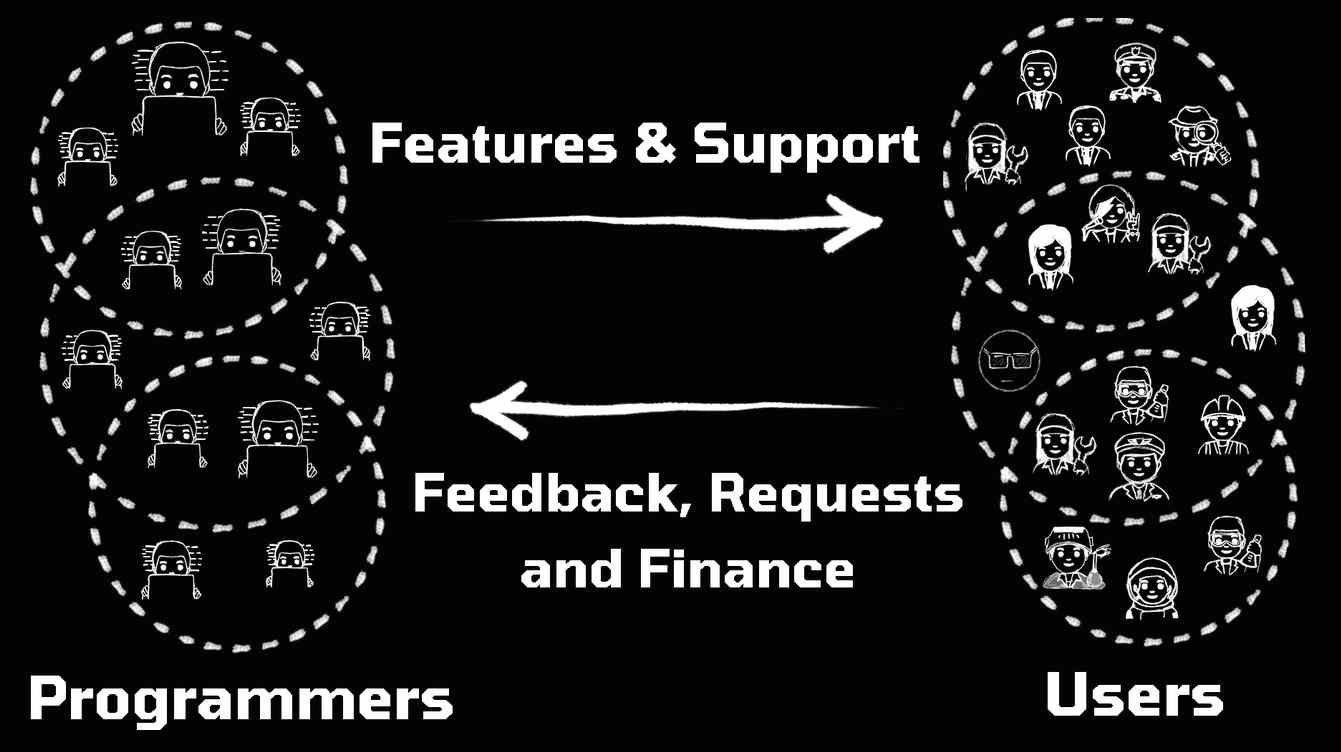
Businesses and consumers need support and features. They use money to get high-quality things right now. They want premium, good software. They want to pay for it to exist, and they want someone to do the work required to make that money get well spent.
Programmers need to finance for our tools and libraries, which benefit businesses a ton. Paid work to build open source for consumers and businesses yields a ton of open source back that we can use to scratch our own itches. We'll do the building if they will just give us high quality feedback and pay us.
Free-tier users create the idea capital and customer service. Paying consumers and businesses foot the bills. The programmers take a cut in order to work on their own tools while building what needs to be built. It takes at least three legs to make a decent table. Those are the three legs.
Last Call For the Courageous
The opportunity cost of waiting has added up like the tick-tick of the debt clock. We kept moving. While you hesitated:
- Our second and third engineers lost stock options because they didn't send a resume at careers@positron.solutions.
- Our co-founders didn't open pull requests on µTate, so we met someone else later.
- An angel investor thought our strategy was really unique and robust, but didn't ask us for an IR and wound up burning money on some ChatGPT gift-wrap artist with a haircut.
- A user community didn't attract developers to work on their beloved tool because one user didn't sign up to show others the way.
Building µTate is default-viable. By 2027 you will be trying to latch onto a sure thing. To get your name on a slice, you will eventually decide that you want to go harder and be better. If you will decide to go harder and work smarter in the end, you might as well resolve to be better and go harder now.
Running With Stylus
Radiant goddess, white wolf of the divine brush, encircle the calendars of the virtuous with the blesses of your ink. Slice through the paralytic fears of those pitiful creatures lost in their ignorance of your brilliance.

Continue sweeping this winter's powders into the soundless snow drifts of Hokkaido. Reignite audacity within each soul as you awaken the spring cherry trees in Fukuoka. Peacefully guide along the flood waters of the Seoul summer rainy season. Rest once more as we exhale your abundances, shedding our heavy fall leaves in the contemplative stillness ahead of the next winter's early nights.
Unite us in shared wonder at your splendor, and connect us within ourselves through the continuous rhythm of this winter and each next. Thus we trust in the wordless wisdom of your immortal journey, whether with us on Earth or sailing on toward the celestial plane.